Toilet Repair Saint Johns FL
A toilet that runs, flushes weakly, rocks underfoot or seeps at the base wastes water and can quietly damage the subfloor beneath it.
Call to discuss your plumbing problem and check available service options. Availability varies by provider, location and type of work.
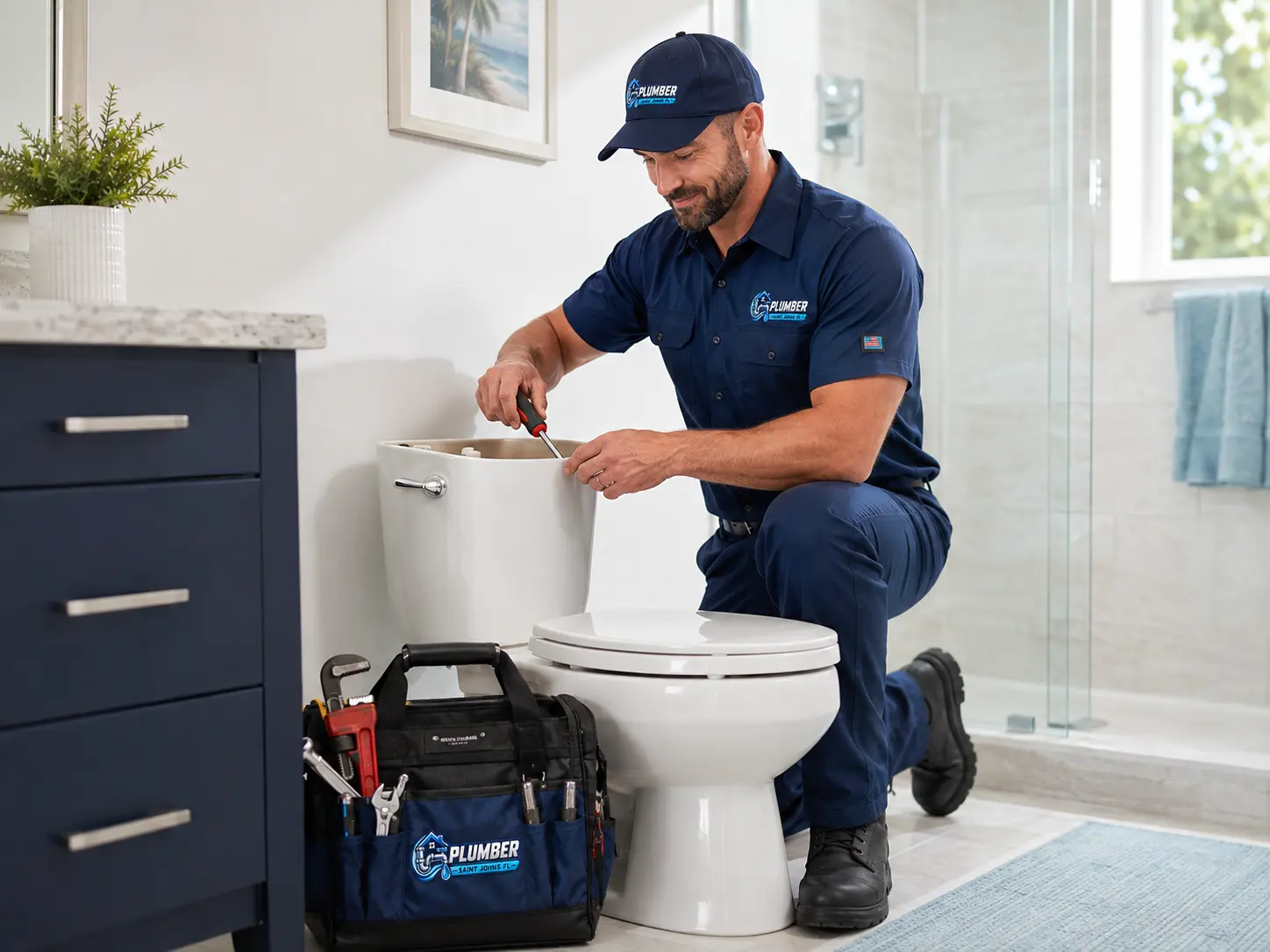
Toilets are simple machines, and most of what goes wrong with them comes down to a handful of parts inside the tank, the seal at the base, or the flange bolted to the floor. The trouble is that two of those three fail invisibly — a silent tank leak wastes water without a sound, and a failed base seal releases water into the floor rather than onto it.
This page covers what each symptom typically means, what can be checked safely at home, and when a repair should be handled by a plumber.
Symptoms and What They Suggest
- Water running continuously or cycling on its own
- A flush that is weak, slow or fails to clear the bowl
- Having to hold the handle down to complete a flush
- The bowl level dropping on its own between uses
- Movement or rocking when you sit down
- Water appearing on the floor around the base
- A persistent sewer odor near the toilet
- Stains or softness in the flooring around the fixture
- Gurgling in the bowl when another fixture drains
Common Causes
- Worn flapper
- A warped or coated flapper cannot seal, letting water pass from tank to bowl continuously.
- Fill valve failure
- The valve fails to shut off cleanly, cycling the tank or running into the overflow.
- Chain or handle issues
- A chain that is too long, too short or tangled prevents a complete flush cycle.
- Blocked rim jets
- Mineral buildup under the rim starves the bowl of the swirl needed for a strong flush.
- Failed wax seal
- A compromised seal at the base allows seepage into the subfloor with each flush.
- Damaged closet flange
- A cracked or corroded flange lets the toilet move and prevents a lasting seal.
- Tank-to-bowl gasket
- A deteriorated gasket or loose bolts leak from the back of the fixture.
- Partial drain blockage
- An obstruction in the trapway or branch line causes weak flushing and gurgling.
What Toilet Repair Involves
The first step is separating tank problems from drain problems, since a running toilet and a weak-flushing toilet have almost nothing in common mechanically. A dye test in the tank confirms a silent leak in seconds, and watching a full flush cycle with the lid off shows whether the flapper, the chain or the fill valve is misbehaving.
Tank-side repairs are usually a matter of replacing the flapper, fill valve or flush assembly and setting the water level correctly. Where the complaint is at the base, the toilet is pulled so the flange and seal can be inspected, because reseating without looking simply repeats the failure. A flange that has cracked or corroded is repaired or replaced before the fixture goes back down, and the toilet is shimmed level and set so there is no movement.
When flushing is weak across more than one fixture, or when a bowl gurgles as something else drains, the problem is not really the toilet — it belongs with drain cleaning or sewer line service.
When to Call a Plumber
- The toilet rocks or has water appearing at the base
- Flooring near the toilet feels soft or has discolored
- A clog will not clear with a flange plunger or closet auger
- You suspect an object was flushed
- More than one fixture is affected at the same time
- The fixture has been rebuilt before and problems keep returning
Call 904-606-8252 to discuss your plumbing problem and check available service options in Saint Johns.
What You Can Safely Check
Safe to check yourself
- Dye-test the tank for a silent flapper leak
- Adjust the flush chain length so it is not slack or taut
- Check the water level against the mark inside the tank
- Close the stop valve behind the toilet to stop an overflow
- Use a flange plunger with a proper seal on a soft clog
- Dry the floor and watch where water reappears
Leave to a plumber
- Chemical drain openers in a toilet bowl
- Overtightening tank or floor bolts against porcelain
- Shimming a rocking toilet instead of resetting the seal
- Forcing an auger past firm resistance
- Reusing an old wax seal after pulling a toilet
- Ignoring odor near a toilet that has ever leaked
Toilet Issues in Local Homes
Two things drive most toilet calls around Saint Johns. The first is hard-water mineral content, which coats flappers and rim jets and is the quiet reason a fixture that flushed fine for years now needs the handle held down. The second is age: in Julington Creek and Fruit Cove, plenty of original fixtures are still in place, and their internal parts have been cycling for a long time.
Humidity plays a part too. Tank condensation in the warm months is common enough here that it is regularly mistaken for a base leak, which is why drying the area and watching the pattern is a useful first step. In two-story homes across Durbin Crossing and RiverTown, a failed seal upstairs typically shows up as a ceiling stain below rather than anything visible in the bathroom itself.
Replacing a fixture rather than repairing it falls under fixture installation.
Plumber Saint Johns FL helps homeowners find plumbing information and connect with available plumbing service providers. Service may be performed by an independent plumbing provider. Availability varies by provider, location and type of work.
Frequently Asked Questions
Why does my toilet keep running between flushes?
Almost always the flapper or the fill valve. A flapper that has warped or grown a mineral film no longer seats fully, so water trickles from tank to bowl until the level drops enough to trigger a refill. A fill valve that will not shut off completely produces the same cycling, often with water running down the overflow tube. Both are inexpensive parts, and the waste from ignoring them is substantial because it runs continuously and silently.
What causes a weak or incomplete flush?
A weak flush usually means either not enough water is being delivered or something is restricting the path out. Common causes are a tank level set too low, a flapper closing early, mineral deposits blocking the rim jets under the bowl rim, or a partial obstruction in the trapway or the drain beyond. Checking the tank level and the rim jets first is worthwhile, since those are the easiest to correct and account for a good share of complaints.
Is a rocking toilet a real problem?
Yes. Movement breaks the wax seal between the toilet and the closet flange, and once that seal is compromised, small amounts of water and waste escape under the base each time the toilet is used. Because it goes into the subfloor rather than onto the floor surface, it is often not noticed until the flooring softens or an odor develops. A rocking toilet should be pulled, inspected and reset rather than shimmed and forgotten.
Why is there water on the floor around the base?
There are three usual explanations and they need different fixes. Condensation on the tank in humid weather drips down and mimics a leak. A failed tank-to-bowl gasket or loose tank bolts release water down the back. A failed wax seal at the base seeps water and waste when the toilet is flushed. Drying the area completely and watching where the water reappears, and when, will usually tell you which one you are dealing with.
Can I use drain chemicals in a clogged toilet?
It is a bad idea. Caustic products sit in the trapway rather than reaching the blockage, generate heat inside a porcelain fixture, and create a hazard for anyone who later plunges or augers the bowl. A flange plunger used with a proper seal clears most soft clogs, and a closet auger handles many of the rest. If an object has been flushed, or if other fixtures are also slow, stop and have it looked at instead.
Should an old toilet be repaired or replaced?
Internal parts are cheap and worth replacing on almost any toilet that is otherwise sound. Replacement becomes the better option when the bowl or tank is cracked, when the fixture has been rebuilt repeatedly, when the flange beneath is damaged and the toilet must come up anyway, or when a very old high-volume fixture is using far more water per flush than a modern one. In a remodel, replacing while access is open usually makes sense.
Service Areas
Serving Saint Johns and nearby communities including:
Other Plumbing Services
Toilet Problem in Saint Johns?
Note whether the issue is running, flushing, movement or water at the base, and call to discuss the repair and current availability.
Call to check current service availability in Saint Johns.